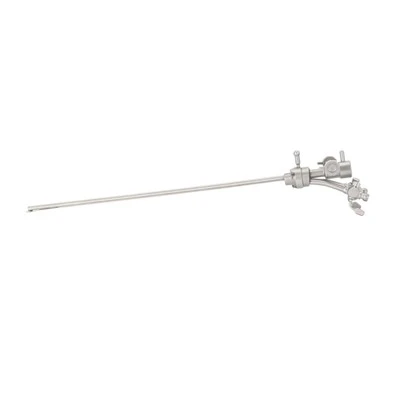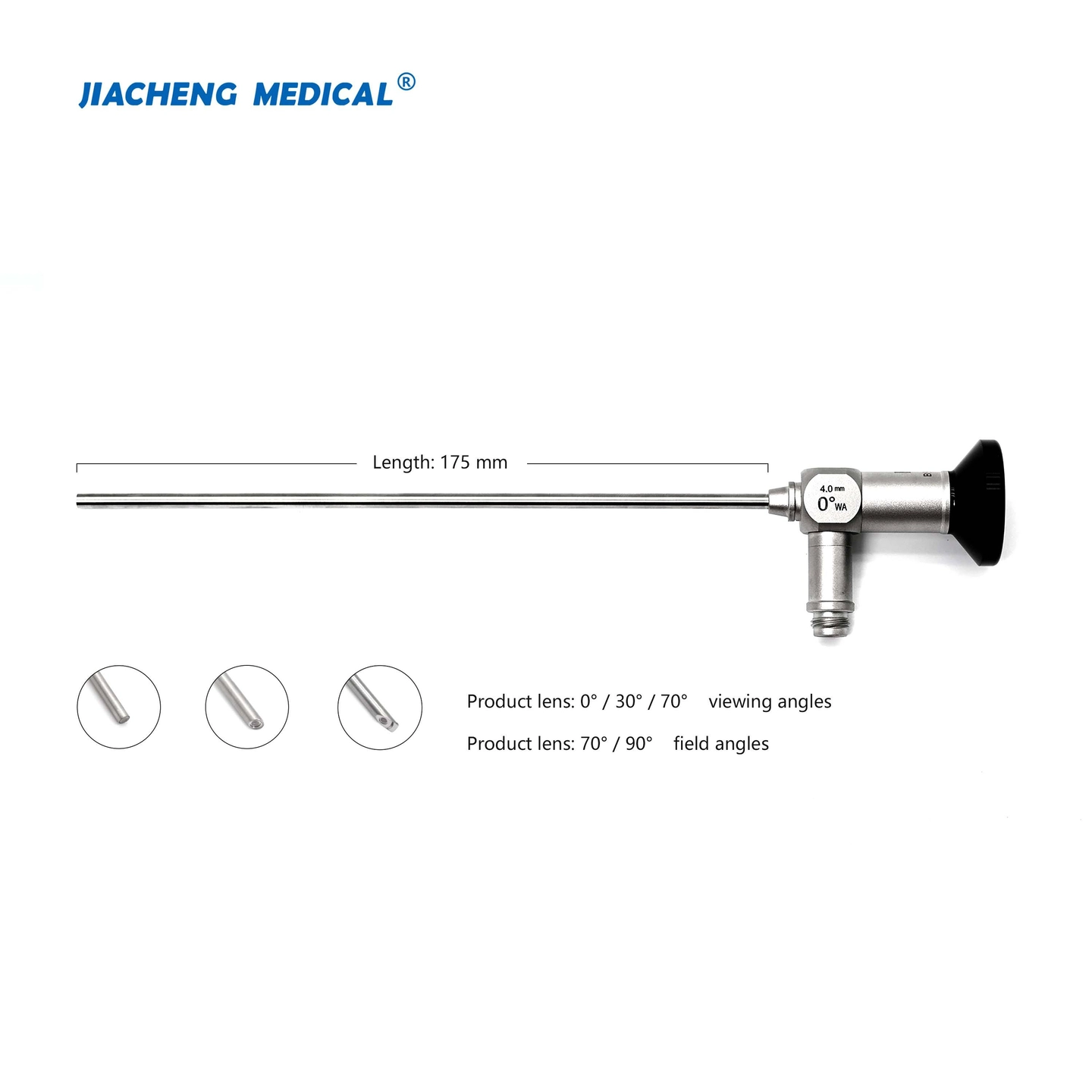



Product Overview
Precision-engineered medical endoscopes built for diagnostic visualization and minimally invasive surgical interventions. Fabricated using medical-grade stainless steel and high-purity optical glass. Designed to integrate directly with standard mechanical camera couplers and high-intensity surgical light sources. Every optical assembly undergoes 100 percent laser-welding hermetic sealing to withstand repeated steam autoclaving and low-temperature plasma sterilization cycles. Export-ready with secure, double-walled industrial packaging compliant with international precision-instrument freight standards.
-
![Sinuscope | 2.7mm / 3mm / 4mm | 0° / 15° / 30° / 45° / 70° | CE | HD | Autoclave | OEM/ODM | Jiacheng]() Sinuscope | 2.7mm / 3mm / 4mm | 0° / 15° / 30° / 45° / 70...A high-precision rigid sinus endoscope engineered for Functional Endoscopic Sinus Surgery (FESS), chronic rhinosinusitis treatment, nasal polyp removal, and nasal cavity examination. Available across the widest configuration range in...view more
-
![Diagnostic Otoscope | 0° / 30° | 2.4 mm / 2.7 mm / 2.9 mm / 3.0 mm / 4.0 mm | CE | HD | Autoclave | OEM/ODM]() Diagnostic Otoscope | 0° / 30° | 2.4 mm / 2.7 mm / 2.9 mm...A rigid diagnostic otoscope specifically designed for otolaryngology (ENT) examination and diagnosis. Unlike standard handheld otoscopes, this rigid scope connects directly to HD digital camera systems, projecting high-definition images...view more
-
![Reusable Laryngoscope]() Reusable LaryngoscopeThe vital physique is made of medical-grade stainless steel, and the optical window makes use of scientific sapphire glass, offering magnificent corrosion resistance, have an impact on resistance, and optical stability.view more
-
![Professional Arthroscope | 0° / 30° / 70° | 1.9mm / 2.7mm / 3.0mm / 4.0mm | CE | HD | OEM/ODM]() Professional Arthroscope | 0° / 30° / 70° | 1.9mm / 2.7mm...A high-performance rigid arthroscope engineered for precision joint surgery under high-definition visualization. Built on a rod lens optical system with HD imaging capability and full autoclave sterilization compatibility, the...view more
-
![Rigid Cystoscope | 2.7mm / 2.9mm / 4mm | 0° / 25° / 30° / 45° / 70° | CE | HD | Autoclave | OEM/ODM]() Rigid Cystoscope | 2.7mm / 2.9mm / 4mm | 0° / 25° / 30° /...A high-precision rigid cystoscope designed for bladder examination, urethral assessment, and urological endoscopic procedures. Available across a comprehensive configuration range — covering three diameters, five viewing angles, and...view more
-
![Operating Hysteroscope]() Operating HysteroscopeOur operating hysteroscope is intended for intrauterine observation and diagnosis, suitable for use without an instrument channel or with an extremely small channel (≤ 3Fr). Equipped with 4K ultra-high-definition imaging technology, it...view more
-
![Rigid Laparoscope | 0° / 30° | 5 mm / 5.5 mm / 10 mm | CE | HD | Autoclave | OEM/ODM]() Rigid Laparoscope | 0° / 30° | 5 mm / 5.5 mm / 10 mm | CE...A precision rigid laparoscope designed for general surgery, obstetrics and gynecology, and urology departments. Available in 0° and 30° viewing angle configurations across 5mm and 10mm diameters, with working lengths of 305mm and 330mm....view more
-
![Sinoscope-Value Series | 0° / 15° / 30° / 45° / 70° | 2.7mm / 3mm / 4mm| CE | HD | Autoclave | OEM/ODM | Jiacheng]() Sinoscope-Value Series | 0° / 15° / 30° / 45° / 70° | 2.7...A dependable rigid sinus endoscope designed for routine ENT examination and standard FESS procedures in moderate-use clinical environments. Available across a broad configuration range — covering three diameters, five viewing angles,...view more
-
![Therapeutic Otoscope | 0° / 30° |2.4 mm / 2.7 mm / 2.9 mm / 3.0 mm / 4.0 mm | CE | HD | Autoclave | OEM/ODM]() Therapeutic Otoscope | 0° / 30° |2.4 mm / 2.7 mm / 2.9 mm...A rigid therapeutic otoscope engineered for operative otolaryngology procedures. Designed for direct access to the ear canal, tympanic membrane, and middle ear structures, with a 0° direct-view optical configuration for clear forward...view more
-
![Laryngoscope Rigid]() Laryngoscope RigidThe laryngoscope rigid is a one of a kind inflexible endoscope for otolaryngology, generally used in medical anesthesia, emergency resuscitation and otolaryngological examinations to expose the shape of the pharynx and larynx, aid in...view more
-
![Standard Arthroscope | 0° / 30° / 70° | 1.9mm / 2.7mm / 3.0mm / 4.0mm | CE | HD | Cost-Effective OEM]() Standard Arthroscope | 0° / 30° / 70° | 1.9mm / 2.7mm / 3...A reliable rigid arthroscope suited to routine joint examination and standard operative arthroscopy. The Standard Arthroscope delivers clear HD-compatible imaging for knee, shoulder, and hip procedures within a validated sterilization...view more
-
![Reusable Disinfection Cystoscope | 2.7mm / 2.9mm / 4mm | 0° / 25° / 30° / 45° / 70° | CE | HD | OEM/ODM]() Reusable Disinfection Cystoscope | 2.7mm / 2.9mm / 4mm | ...A cost-effective rigid cystoscope designed for bladder examination and urological endoscopic procedures in clinical environments where high-temperature autoclave sterilization is not required or available. The Reusable Disinfection...view more


Types and Configurations
Rigid Endoscopes
Rod-lens optical systems engineered for arthroscopy, laparoscopy, and hysteroscopy. Available outer diameters: 2.7 mm, 4.0 mm, 10 mm. Available directional angles: 0 deg, 30 deg, 45 deg, 70 deg.
Flexible Endoscopes
Fiber-optic and chip-on-tip video instruments designed with multi-way shaft articulation and durable braided stainless steel insertion tubes.
Bariatric and Pediatric Variants
Specialized outer diameters and working lengths tailored to specific anatomical access and depth requirements.
Technical Specifications
|
Model Series |
Outer Diameter (OD) |
Working Length |
Field of View (FOV) |
Direction of View (DOV) |
Light Transmission |
|
LAP-4030 |
10.0 mm |
315 mm |
85 deg |
30 deg |
Fiber bundle greater than 70 percent |
|
ART-2700 |
4.0 mm |
175 mm |
70 deg |
0 deg |
Fiber bundle greater than 75 percent |
|
URO-2730 |
2.7 mm |
280 mm |
75 deg |
30 deg |
Rod lens array |
|
GI-9014 |
9.2 mm |
1050 mm |
140 deg |
Forward (0 deg) |
CMOS Sensor and LED |

General Surgery and Laparoscopy: Cholecystectomy, appendectomy, and hernia repair via standard 10 mm and 5 mm abdominal trocar ports.
Orthopedic Arthroscopy: High-resolution joint visualization of the knee, shoulder, and wrist using 4.0 mm rigid scopes with wide-angle optics.
Urology and Gynecology: Transurethral resection and hysteroscopic diagnostic procedures utilizing 2.7 mm and 4.0 mm small-caliber insertion tubes.
Gastroenterology: Upper and lower gastrointestinal tract examinations utilizing distal-tip CMOS high-definition imaging modules.
Optical System and Construction
Lens Assembly
Multi-layer anti-reflective broadband optical coatings minimize internal glare and light dispersion across rod-lens relay systems.
Sapphire Window
Distal and proximal optical windows utilize single-crystal synthetic sapphire, providing high scratch resistance.
Housing
Laser-welded stainless steel outer tubing prevents fluid ingress during high-pressure immersion and clinical operation.
Light Guide
High-purity quartz fiber bundles deliver uniform illumination across the target field without thermal hot spots at the distal tip.
Sterilization and Compatibility
Autoclave Resistance
Fully compatible with steam sterilization parameters at 134 deg C up to 2.5 bar for up to 1,000 validated cycles.
Low-Temperature Sterilization
Compatible with hydrogen peroxide gas plasma systems, ethylene oxide (EtO), and approved chemical immersion disinfectants.
Camera Interface
Universal mechanical adapter dimensions fit standard C-mount couplers used across medical video processors.
Cleanroom Production: Final assembly executed in controlled cleanroom environments with ESD-safe workstations.
Inspection Protocol:
- Optical resolution and modulation transfer function testing via standardized test charts.
- Helium mass spectrometer leak testing verifying hermetic seal integrity (less than 10 to the power of -8 Pa m3 per second).
- Mechanical tensile strength testing on insertion tube joints exceeding 150 N.
Traceability: Laser-etched matrix identification codes applied to every handpiece housing for complete manufacturing batch tracking.
Quality Management: Production executed under established quality management systems.

OEM, Customization and Technical Support
Custom Engineering
Tailored outer diameters, working lengths, field-of-view angles, and custom laser-engraved institutional or brand markings.
Prototype Turnaround
Rapid prototyping and optical simulation sample delivery scheduled within 14 business days.
Regulatory Dossier
Complete technical documentation packages provided to support customer regulatory submission files.
Repair Services
Modular component replacement and optical realignment services managed within a 5-working-day turnaround window.
FAQ
We're well-known as one of the leading endoscope manufacturers and suppliers in China, specialized in providing high quality customized service to global clients. Please feel free to buy discount endoscope from our factory. Contact us for more details.